By the time someone sees your product on a shelf, they already have an opinion about it.
Most founders don’t realize where that opinion came from.
In this article
If you sell a physical product and are already in retail, this breaks down how customers actually encounter brands today, why packaging and materials still matter deeply, and how social, photography, and retail reinforce each other when they’re designed with intention.
Social Media Is the First Shelf: How Packaging, Photography, and Retail Work Together Now
For a long time, the store shelf was treated like the main event. Packaging was designed to compete under bright lights, from several feet away, surrounded by similar products. That way of thinking shaped how brands invested in materials, finishes, and form.
The shelf still plays an important role. It just isn’t where first impressions are formed anymore.
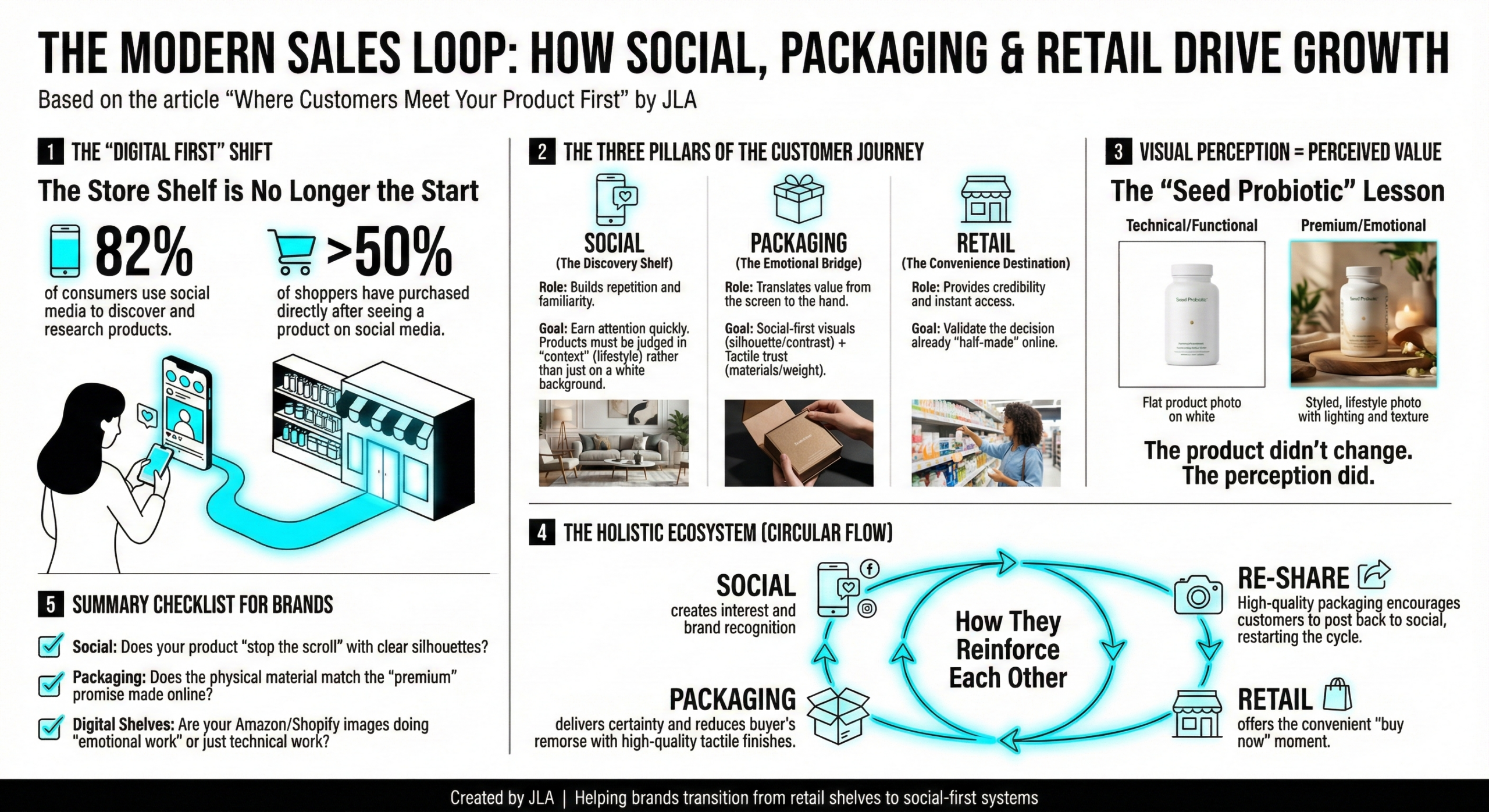
Most customers now encounter products earlier, usually on their phones. Research shows that roughly 82% of consumers use social media to discover and research products, and more than half of shoppers have purchased something after seeing it on social media. By the time a customer encounters a product in store, the decision is often already half‑made.
Where Product Familiarity Is Built Today
Social media is where familiarity forms now, often before a customer has any buying intent.
This is especially true for brands stocked at high‑end grocers like Whole Foods, Erewhon, and Sprouts. Retail placement creates credibility and access, but social creates repetition. It introduces the product to people who may not shop those stores regularly and builds recognition long before a shelf moment exists.
On social platforms, products aren’t evaluated the way they are in stores. They’re judged in context, alongside people’s routines, taste, and trust signals. A product isn’t just competing with other products. It’s competing with attention.
What Packaging Needs to Do in a Social‑First Market
Packaging still matters deeply. Its role has expanded.
On social, packaging has to earn attention quickly. Shape, color, contrast, and silhouette need to read clearly on a small screen. If a product doesn’t photograph well or feels visually quiet online, it struggles to stop the scroll.
In hand, packaging does something different and just as important. It reassures the customer. It reinforces quality and confirms that the product was worth the investment.
This is especially critical for premium, wellness, and lifestyle brands. Materials and finishes aren’t decorative details. They are trust signals.
Why Product Context Drives Perceived Value
A well‑made product can still underperform if the way it’s shown doesn’t translate its value.
For example, a Seed probiotic jar photographed on a white background looks clean and competent, but it doesn’t communicate the tactile experience. You don’t feel the frosted glass or the weight of the jar. The product can appear quieter than it actually is.
Placed in a styled environment with intentional lighting, depth, and a sense of space, that same product feels more premium and more considered.
[Image placeholder: Seed probiotic — flat pack on white]
[Image placeholder: Seed probiotic — styled lifestyle or gradient background]
The product didn’t change. The perception did.
The Digital Shelf Exists Across Social, Ecommerce, and Retail
Today, your product lives on many shelves at once.
Amazon product listings.
TikTok Shop product cards.
Shopify product pages.
Instagram Shopping.
These are all decision points. Flat pack images may satisfy technical requirements, but they rarely do the emotional work needed to earn attention and trust. Strong product photography now has to imply texture, lifestyle, and value because it’s standing in for touch.
If an image doesn’t hold attention, it doesn’t convert.
How Social, Packaging, and Retail Reinforce Each Other
Social exposure builds recognition before a customer ever enters a store. Retail provides convenience when they’re ready to buy. Packaging connects the two.
When the expectations set online align with the experience a customer has in hand, the journey feels seamless. The product makes sense. The brand feels trustworthy. The purchase feels validated.
This alignment is especially important for small to mid‑sized brands that are already in some retail locations and beginning to invest more seriously in social selling. Without a large in‑house team, clarity and cohesion matter even more.
Why Packaging and Materials Still Matter at the Moment of Delivery
When a customer receives your product, the details matter. The weight of the container. The materials. The finishes. These elements reassure the customer that they made the right choice.
For higher‑priced products, this reassurance is part of the value. It reduces buyer’s remorse and builds confidence, which is what leads to repeat purchase.
Social creates interest.
Packaging delivers certainty.
How We Guide Brands Through This Shift
At JLA, we work with growing product‑based brands that are already in retail and ready to strengthen their social presence without building a full in‑house team.
We look at packaging, photography, and content as one system. Not as separate deliverables. Our role is to help brands translate what makes their product special into visuals that perform on the scroll and then ensure the in‑hand experience delivers on that promise.
If you’re stocked in retailers like Whole Foods, Erewhon, or Sprouts and starting to feel the pressure to show up more intentionally on social, this is the moment where thoughtful creative direction makes the biggest difference.
That’s where we come in.
For our visual learners ❤