Search for AI product photography right now and you’ll get a dozen versions of the same article, each ranking twelve tools against each other. Which is fair enough, because two years ago “which tool” was the real question and the honest answer was “none of them yet.”
That’s changed. The tools are genuinely good now, they’re getting cheaper every quarter, and for a lot of work they’re the right call. What we keep seeing is founders who’ve already worked that out, tried three of them, and arrived somewhere the listicles don’t go: the tool works fine and the images still aren’t usable.
THE QUICK VERSION
AI product photography now splits into two purchases rather than one. Tools sell generation, which has gotten cheap and will keep getting cheaper. Directed shoots sell everything downstream of generation: creative direction, exact label reproduction, one consistent model across a set, realism review, disclosure handling, and someone accountable when a delivered set is wrong. The useful cost comparison is a production day, not a subscription.
What the tools genuinely do well
Worth saying plainly, because a lot of agency writing on this is quietly self-serving. If you’re shooting a single SKU with no people in the frame, you have a good eye, and you have a few hours, current tools will get you most of the way there and the money is better spent somewhere else. We use those same tools every day, which is the whole reason we’d rather be honest about them. They’re where our own work starts.
Generation is the part that got solved. Anyone with a card on file can produce a thousand images of a supplement bottle this afternoon, and that number will be ten thousand before long.
What didn’t get solved is knowing which ten of those thousand will make somebody stop scrolling and read the label. That’s a different job, and it got harder rather than easier as the volume went up, because there are more frames to reject now and the failures are subtler than they were when the models were obviously bad.
Where a self-serve workflow breaks
Four things, and they show up in roughly this order as a brand scales past its first set.
The first is label fidelity. Generative models are confident and approximate, so they’ll invent copy on a label, warp a lockup, and drift a color far enough that a whole set looks slightly wrong without anyone being able to say exactly why. In practice that looks like an ingredient line that says something almost but not quite right, a registered trademark symbol that migrates half a centimeter between frames, or a brand blue that’s a shade off in four images out of thirty and correct in the rest. None of it is obvious in isolation and all of it is obvious across a product page. Locking the real label from real references before generation begins is a production step, and skipping it is the most common reason a DIY set reads off.
The second is character consistency. One model across an entire set is a technical problem rather than a stylistic preference, and a face that shifts between frames reads as a stock library, which dismantles the impression of a real shoot faster than any other error.
The third is realism review. Plastic skin, flat light, hands that never quite resolve, saturation that reads synthetic to a viewer who couldn’t tell you why it does. Someone has to look at every frame and reject the ones that fail, and that judgment doesn’t come out of a settings panel.
The fourth is accountability, which gets the least attention and probably deserves the most. When a delivered set is wrong, somebody has to fix it, and all a subscription can offer is a help center. That’s the whole distinction between a tool and a vendor, and it’s the one thing a feature comparison will never surface. It’s also the same thing we’d tell a founder to look at when they’re choosing any creative partner.
The line item that appeared this year
There’s a fifth thing now, and it caught most brands off guard because it didn’t exist when they set up their process.
Three separate rules landed on AI imagery in 2026, and they’re pointed at different people. New York’s applies to advertisers but only when there’s an AI-generated person in the ad. California’s sits with the AI providers rather than with brands (which is the one that gets misread most often). And Article 50 of the EU AI Act can put a disclosure obligation on the company publishing the image, which means brands selling into Europe. We wrote up the full picture in AI image disclosure and where the decision belongs, because it deserves its own article rather than a paragraph here.
The part that matters commercially is simpler. All of that gets handled at generation, not at upload. Whether a synthetic person appears in the frame, whether you need a version carrying a brand-typeset disclosure alongside a clean one, and which version runs on which platform in which market are production decisions, and they’re either built into how the imagery gets made or they’re a scramble every time a campaign expands.
Which flips the assumption the market has been running on for two years. AI imagery has been treated as the legally risky option and a studio day as the safe one. What the rules actually did was make unmanaged AI the risky one, because the obligations attach to the published image regardless of who generated it. Switching to a cheaper tool moves that work onto your desk rather than removing it.
Measured against the right thing
The instinctive comparison is an agency package against a tool subscription, and it produces a bad answer because the two aren’t substitutes.
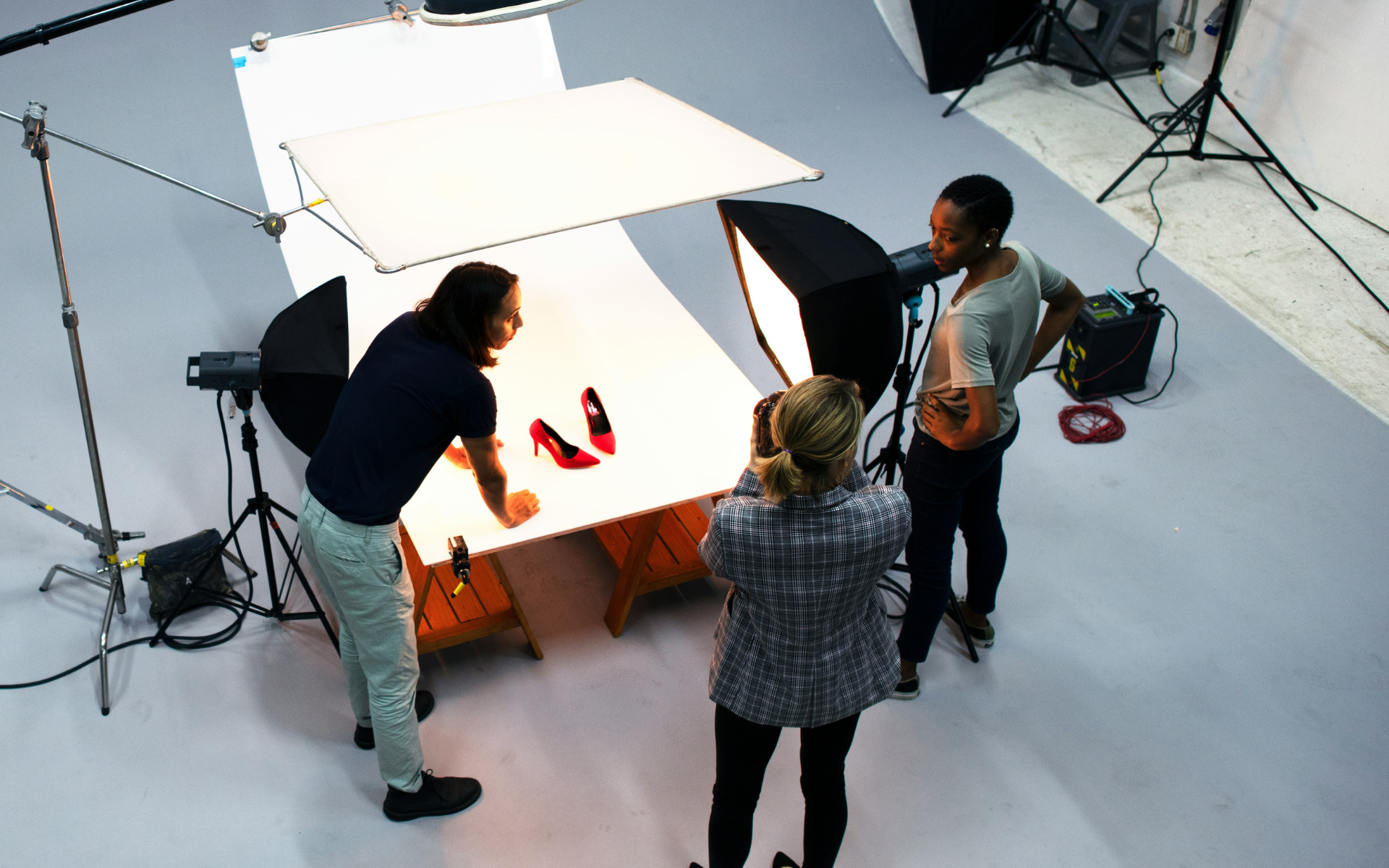
The comparison that works is a production day. In our own scoping, a real one runs into five figures once studio, crew, casting, styling, retouching, and several weeks of calendar are accounted for, and that’s the cost an AI shoot removes. Against that number a package reads as a cheap production rather than an expensive photo.
The second comparison worth running is your own consumption. A brand running paid, organic, product pages, and email is burning through imagery faster than any seasonal shoot cycle was built to supply, and that’s a supply problem rather than a photoshoot problem. It’s also why the economics change after the first set. The expensive part is the setup, meaning the label locked, the model built, the lighting and color and surfaces established, and the decision about what the brand looks like in this medium at all. We call that the Look Lock and it happens once. Everything afterward reuses it, which is why the returning rate drops to $75 a shot and a monthly retainer runs $1,500. Nothing in a subscription remembers your brand between sessions.
There’s an honest limit on that. If you need one seasonal set and nothing after it, the compounding never arrives and it should be priced as a one-off, which we’ll say on a call rather than sell you a retainer you won’t use.
When we’d point you somewhere else
We run both AI and live shoots, so the useful version of this answer isn’t a pitch for one of them.
AI earns its place on volume and consistency: multi-SKU lineups, product page sets, ad variations, seasonal recolors, anything needing forty usable frames of a bottle in contexts that would each take their own setup day.
A live shoot earns its place when texture, physical behavior, or trust is doing the selling. Food has to steam. A serum’s actual viscosity is often the entire proposition. We’d protect founder and team imagery from AI in nearly every case, along with anything running on the surfaces where a customer decides whether to believe you at all, which is roughly the same line we drew in what we’ve been noticing about brands using AI right now.
Most brands we work with end up running both, with the camera carrying the things people need to believe and AI carrying the volume. That split usually becomes obvious about ten minutes into talking through a brief, and it’s genuinely hard to work out from a pricing page.
The first few AI shoots are about whether the images can be made at all. The interesting shift comes later, when imagery stops being something a brand commissions two or three times a year and becomes something it operates, and the question changes from what a set costs to what the creative supply costs per month.
If you’re weighing tools against a shoot, or you’ve got a folder of generated frames that almost worked, that’s a conversation rather than a checkout. Book a shoot call and we’ll go through what you need to make, where it needs to run, what makes sense to produce with AI, and what deserves a camera and a crew. If you’d rather see the quality on your own label first, a $500 sample set shoots three frames and credits toward any package booked within 30 days.